Festivals & Culture
Kodungallur Bharani
Where devotion turns wild and tradition breaks all boundaries.
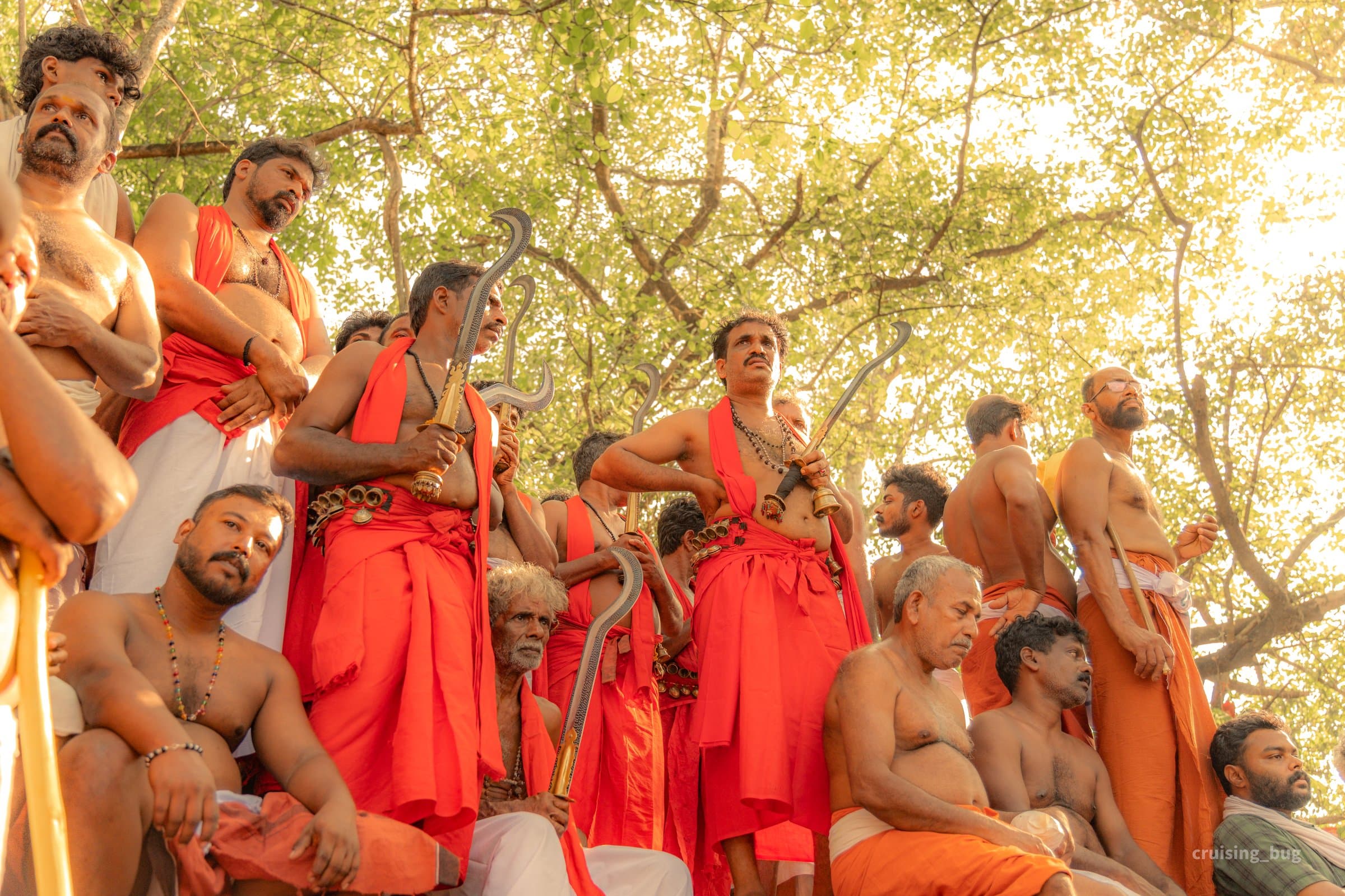
Kodungallur Bharani is one of Kerala’s most intense and unconventional temple festivals, celebrated at the Kodungallur Sree Kurumba Bhagavathy Temple in honor of Goddess Bhadrakali (daughter of shiva). Held during Kumbham and Meenam of the Malayalam calendar, the festival is celebrated for mythological victory of the goddess Bhadrakali over the demon called Darika. Rooted in ancient traditions, it stands apart from typical temple rituals by embracing raw, uninhibited expressions of devotion that reflect both history and deep cultural identity.
What defines Bharani is its powerful and chaotic ritual energy—devotees, often in trance, enter the temple by dressed in red, singing ritualistic Bharani Paattu and performing acts that breaks social norms. Oracles run through the temple wielding swords or sticks, resembling possession by the goddess, while the atmosphere transforms into a space where order dissolves into collective emotion and faith. This unique blending of devotion, rebellion, and ritual makes the festival a striking expression of spiritual intensity and cultural freedom.
In front of the temple, devotees offer red silk cloths and drape them over sacred stones associated with the goddess, a ritual known as part of Kozhikkallu Moodal. These stones are symbolically linked to the mythological battle of Goddess Bhadrakali, and covering them in red cloth represents blood, evoking the energy of war and sacrifice.
This act is understood as preparing the goddess for battle—an offering that visually and spiritually recreates the moment before combat, where devotion takes the form of invoking power, aggression, and protection. The red cloth transforms the space into a symbolic battlefield, reinforcing the festival’s core theme of divine fury and victory.
Each village or community establishes its own madapam (temporary sacred space), usually set beneath a peepal tree around the Kodungallur Sree Kurumba Bhagavathy Temple. These spaces act as localized ritual centers where devotees gather, prepare offerings, and perform their community-specific rites, reflecting the collective participation of multiple groups in the festival’s structure. This decentralized ritual setup is a characteristic feature of Bhagavathy festivals, where each community expresses its identity through its own ceremonial practices.
After completing these rituals, the Velichappadu (oracles)—believed to be possessed by the goddess—enter a trance state and move towards the main temple. In a surge of ritual energy, they run into the temple surroundings and circle it repeatedly, often wielding swords or sticks, as part of the Kaavu Theendal ceremony. This act symbolizes both purification and the collective offering of devotion, forming one of the most intense and defining moments of the Bharani festival.
In a state of intense trance, the Velichappadu (oracles) are believed to be possessed by the goddess, and in this heightened ritual state, they repeatedly strike their foreheads with their own ceremonial swords, allowing blood to flow as an offering. This act symbolizes absolute surrender and devotion, where the body becomes a medium for the divine, and the blood itself is seen as a sacred offering rather than injury. Despite the visible violence, they appear unaffected by pain, sustained by the psychological and spiritual intensity of possession, making it one of the most raw and powerful expressions of faith during the Bharani festival.
Swords in the Kodungallur Bharani festival are not just weapons but powerful ritual symbols carried by the Velichappadu (oracles) as extensions of the goddess herself. Held during trance, these ceremonial blades represent divine authority, war, and the mythological battle of Bhadrakali against Darika. The oracles wield them while dancing, striking temple structures, and even their own foreheads, transforming the sword into an instrument of devotion, sacrifice, and spiritual connection rather than violence.
And as the frenzy fades and the temple falls silent, the echoes of devotion remain—reminding us that faith here is not gentle, but fierce, raw, and unapologetically alive.